
Is seeing believing?
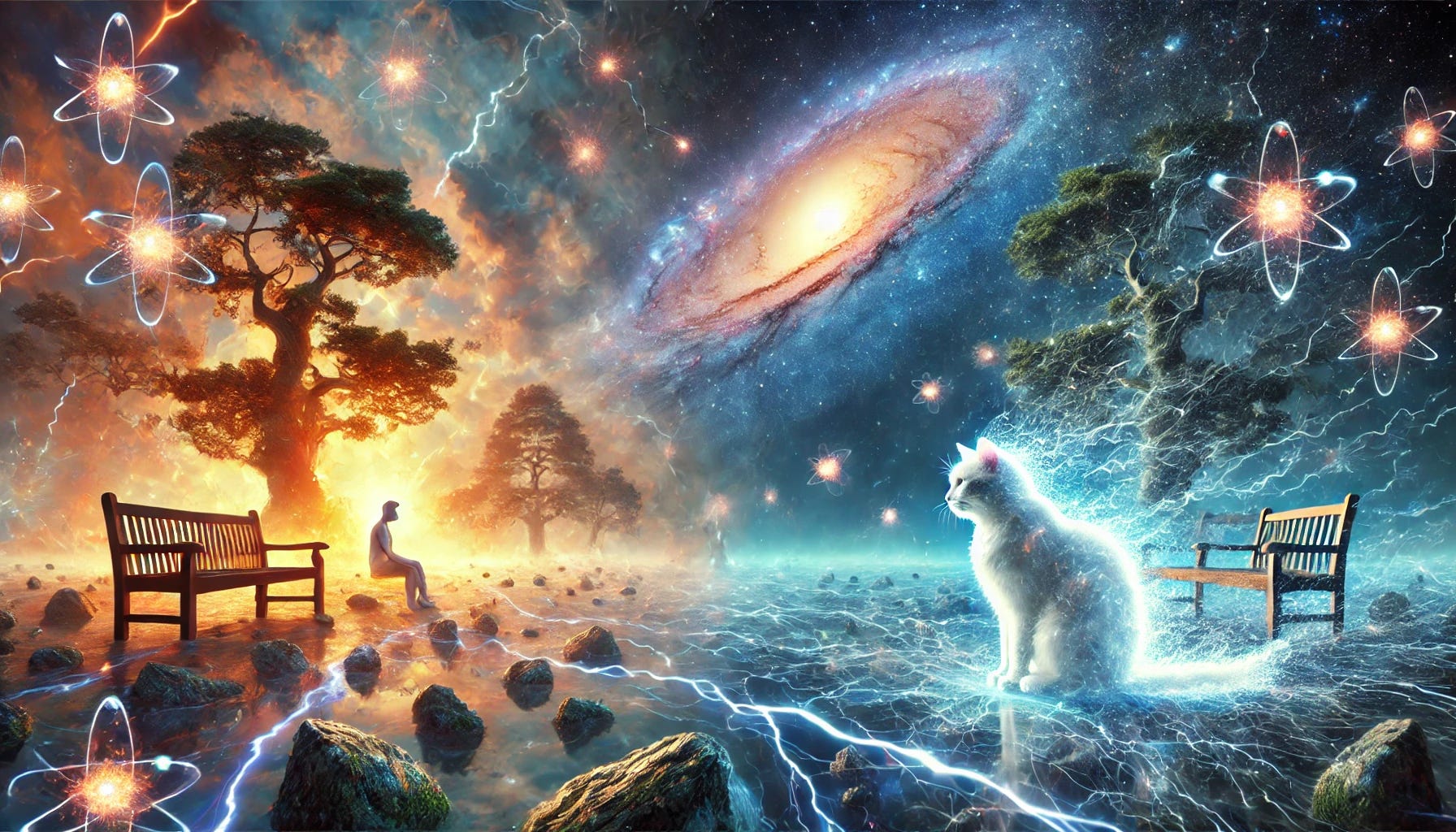
Everything we know is energy – galaxies, planets, rocks, trees, animals, and humans. Our thoughts and emotions are energy, Our memories of the past and dreams of the future are energy.
All of these things, in their essence, are energy. We sense them as things rather than "energy", because the energy manifests itself in ways that we have learned and decided to call "solid", "liquid", "gas", "thoughts", "emotion", "dream", and "memory".
Said differently, there is reality ("everything is energy"), and there is how we sense and name that reality ("solid", "liquid", "emotion", "memory"). Both of these (the results of the sensing, and the reality itself) exist at the same time.
This realization explains the otherwise impossible contradictions between quantum mechanics and classical mechanics. Quantum mechanics explains how reality behaves at extremely small scales. The famous metaphor uses a cat that is alive and dead in a box at the same time. Classical mechanics explains how reality behaves at larger scales – why planets have orbits around a star and what happens when a car crashes into a wall. Many experiments, by many people, have proven that both quantum mechanics and classical mechanics are real.
The "impossible contradiction" between them is simple: in classical mechanics, that metaphorical cat can not be alive and dead at the same time. It must be one or the other. Quantum mechanics has a simple explanation for this – the cat is indeed alive and dead, but becomes one or the other when a human looks at it.
In other words, the contradiction is explained when we realize that reality ("everything is energy") is perceived to be something other than energy when we try to sense it for ourselves ("solid", "liquid", "emotion", "memory"). The sheer act of perceiving (literally "making sense of something") causes us to believe that a different set of rules apply (classical mechanics), which contradict the other set of rules (quantum mechanics).
Humans have long had fables that explain this contradictory duality. The most famous such story is of the blind men who touch an elephant. Each one is sure he is touching what he senses (a tree for the legs, or a snake for the trunk). The limits of their ability to perceive obscure the more-fundamental reality – the individual pieces (tree and snake) are actually parts of something much larger, which they cannot see. The elephant.
To close the loop, when we use classical mechanics based on our acts of perceiving, we are seeing trees and snakes. But at the same time, the quantum mechanics description of the elephant is also true.
So what? Why does this matter?
Two thoughts come to mind:
First, this line of thought calls into question the pursuit of a "unified theory", which is the term used for a system of thought that brings quantum and classical mechanics together in a cohesive way. A unified theory would be very useful for teams who are pursuing transformational inventions like fusion power and quantum computing, since right now they have to juggle two very different ways of describing what they are doing. Perhaps, instead of pouring energy into an attempt at unification, we would be better off to accept a simpler explanation: the differences between quantum and classical mechanics are due to the simple act of perceiving.
Second, this line of thought might help to clarify debates between those who believe in the supernatural and those who only believe in the natural world, along with debates between those who are devoutly religious and those who are firmly atheist. Currently, these debates are focused on comparing what is "true" (based on what can be perceived and measured), and what cannot be proven with observable facts. But what if that's the wrong debate altogether? What if the real issue is around perception itself?
Asked most succinctly: is seeing believing?